Evidence over hype
Chernobyl Declassified Records: Sources on the 1986 Disaster
A source trail through Soviet, KGB, IAEA, U.S. intelligence, and radiation records that shows what Chernobyl documents can and cannot prove.
Chernobyl is one of those stories that sounds simple until you start reading the records.
People usually flatten it into one of three versions: a reactor disaster, a Soviet cover-up, or a story about reckless operators. Each version has some truth in it. None of them is enough.
If I were starting from scratch, I would not start with a documentary, a forum thread, or a dramatic death-toll chart. I would start with Chernobyl declassified records and Chernobyl primary sources: Soviet and KGB reports, Politburo discussions, IAEA technical assessments, U.S. intelligence records, radiation maps, oral histories, and later health studies.
The point is not to collect links. The point is to stop making one source do a job it cannot do.
Quick answer: what are the best Chernobyl declassified records?
The strongest starting points are the National Security Archive's Top Secret Chernobyl volume 1, Top Secret Chernobyl volume 2, the Harvard HURI guide to the Wilson Center Chernobyl collection, the IAEA INSAG-7 report, the OSTI record for NUREG-1250, the Reagan Library Chernobyl folder, and the UNSCEAR Chornobyl assessments.
I would read them in this order:
- Soviet and KGB records for warnings, reporting channels, secrecy, emergency response, and public anxiety.
- Politburo documents for high-level reaction, blame, information control, and later recognition of reactor-design danger.
- IAEA and NRC reports for the technical reconstruction.
- U.S. intelligence and Reagan Library records for what outsiders knew, suspected, and got wrong while information was incomplete.
- UNSCEAR records for immediate deaths, radiation sickness, thyroid-cancer evidence, evacuation numbers, and long-term health claims.
- Oral histories for lived experience, displacement, fear, family memory, and the human cost.
- Photographs and maps for place, damage, abandonment, contamination patterns, and memory.
That last distinction matters. A photo of Pripyat can show what Pripyat looked like later. It cannot prove what happened inside Unit 4 at 1:23 a.m.
Source trail at a glance
- Soviet leadership and Politburo records show official reaction, secrecy, crisis management, and what leaders debated after the explosion.
- Ukrainian KGB/SBU records show internal reporting, public-order concerns, classification decisions, and warnings before or after the accident.
- U.S. intelligence and diplomatic records show what outside governments believed, where they were uncertain, and how Chernobyl shaped Cold War perception.
- IAEA, NRC, and technical reports explain reactor behavior, safety culture, and why later assessments corrected the early operator-error story.
- Health, radiation, photos, maps, and testimony are useful evidence, but each has limits. Do not turn them into one easy death-toll or cover-up claim.
Use the companion Chernobyl declassified records source finder to search this source trail directly.
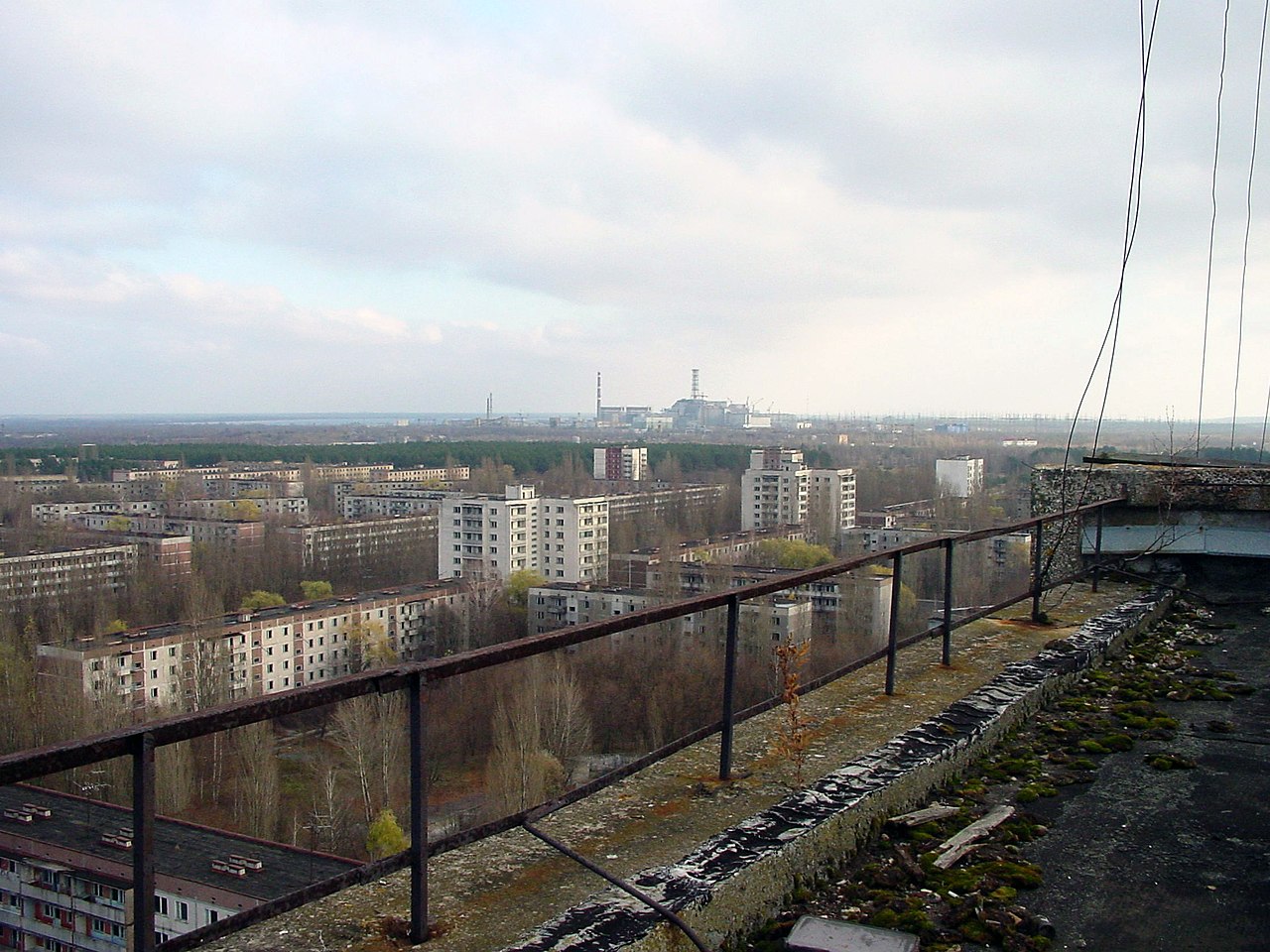
Source: Wikimedia Commons. View of Chernobyl power plant from a residential building in Pripyat, photographed by Jason Minshull and released into the public domain.
The source trail at a glance
Soviet and KGB records
- Best starting point: Wilson Center collection
- What it shows: Internal warnings, notices, public attitudes, evacuation and response reports
- Be careful: Translated curated records, not every surviving Soviet document
Politburo and high-level records
- Best starting point: National Security Archive volumes
- What it shows: Leadership reaction, secrecy, blame, and recognition of design problems
- Be careful: Curated briefing books, so follow document links where possible
Technical accident reports
- Best starting point: IAEA INSAG-7 and NUREG-1250
- What it shows: Reactor design, test sequence, operator actions, accident physics, release estimates
- Be careful: Later technical reconstructions, not direct personal testimony
U.S. intelligence and diplomatic records
- Best starting point: Reagan Library, CIA, and FRUS records
- What it shows: Outside detection, uncertainty, assistance offers, policy response
- Be careful: They show U.S. perception, not direct Soviet decision-making
Radiation and health assessments
- Best starting point: UNSCEAR
- What it shows: Exposure, evacuation, acute radiation syndrome, thyroid-cancer evidence
- Be careful: Scientific population assessment, not a simple death-count scoreboard
Oral histories
- Best starting point: HURI-listed Chornobyl archive projects
- What it shows: Lived experience, evacuation memory, liquidator testimony, family memory
- Be careful: Memory sources are not technical logs or dose measurements
Photos and maps
- Best starting point: Wikimedia and UNSCEAR maps
- What it shows: Physical setting, abandonment, contamination patterns, later memory
- Be careful: Visual context does not prove cause or intent
What happened at Chernobyl?
The Chernobyl nuclear accident happened on April 26, 1986, at Unit 4 of the Chernobyl Nuclear Power Plant near Pripyat in the Ukrainian Soviet Socialist Republic.
A late-night safety test, reactor instability, design weaknesses, control-rod behavior, operating decisions, and institutional failure combined into a reactor explosion and fire.
That summary is true, but it hides the source problem.
People still argue as if the answer has to be one thing: bad operators, bad reactor design, or a bad Soviet system. The records point to a combination.
The early Soviet line leaned hard on operator violations. Later technical reassessments, especially INSAG-7, changed the balance. Operator actions still mattered, but reactor design characteristics, control-rod design, safety systems, operating procedures, and safety culture mattered too.
Then the Soviet and KGB records add another layer: warning signs, reporting channels, secrecy habits, and political incentives shaped the response.
That is why a source trail beats a single explanation.
Start with the Wilson Center Chernobyl collection
The Wilson Center Chernobyl Nuclear Accident collection, also described through Harvard's open Ukrainian-history guide, is one of the best entry points because it brings translated Soviet and Ukrainian records into one place.
The collection includes Ukrainian and national KGB reports, Communist Party directives, and Ukrainian Academy of Science measurements. The documents range from pre-accident construction and operational concerns to immediate emergency reporting, public attitudes, and later discussions of the disaster.
The related Wilson Center guide, 28 Newly Translated Documents on Chernobyl, 1973-1991, helps explain what is in the collection: construction and safety documents from before 1986, notices on radiation levels after the explosion, KGB reports, evacuation information, and later public-response records.
I would not stop at the first archive page. The Harvard HURI Chornobyl browse page points to more open-access Ukrainian-history resources, including Wilson Center materials, Communist Party task-force documents, Kyiv local archive materials, and oral-history collections.
Some of those records are harder to use, especially when documents are in Ukrainian or Russian. But they matter because they pull the story away from only Moscow and only Western intelligence.
These sources can prove that Chernobyl was not only an instant technical accident. They show warning signs, reporting structures, secrecy, emergency improvisation, and the difficulty of controlling public information after radiation had already crossed borders.
They cannot prove everything alone. They are translated and curated. Compare them with technical reports, international measurements, eyewitness accounts, and health assessments.
What did Soviet and KGB records show?
The Soviet and KGB record is powerful because it shows what officials were seeing from inside the system.
These records help with questions like:
- Were there warnings before the disaster?
- How did officials report radiation levels and emergency response?
- What did security services watch after the accident?
- How did authorities understand public fear, rumor, anger, and foreign attention?
- What information was delayed, filtered, or treated as politically sensitive?
The mistake is to read every Soviet or KGB document as a confession. That is not how records work.
A KGB notice may show what one office reported at one moment. A party directive may show what officials wanted done. A radiation measurement may show a data point in one place and time. None of those documents automatically gives you the whole truth.
The value comes from comparison. If a KGB notice says radiation levels were dangerous, a Politburo record shows leaders discussing information control, an IAEA report later reconstructs technical causes, and foreign monitoring records show radiation outside the USSR, then the source trail gets stronger.
Another question is whether Soviet records are reliable if the system itself was secretive. The answer is yes, but only with source criticism.
Secretive states can produce detailed internal records precisely because officials need to report, monitor, classify, and control information. That does not make every document neutral. Ask who wrote it, who was supposed to read it, when it was written, and what incentive the author had.
Did the Soviet Union cover up Chernobyl?
Yes, but the best answer is more specific than the slogan.
The declassified record shows secrecy, delayed disclosure, information management, and political anxiety. The National Security Archive's Top Secret Chernobyl volume 1 frames the documents as evidence of "cover-ups, critiques" and high-level Soviet reaction. It includes Politburo notes, protocols, diaries, KGB materials, and U.S. intelligence records.
That does not mean every Soviet official knew everything from the first hour. It means the state handled the accident through secrecy, internal reporting, delayed public disclosure, and political control at the exact moment when radiation and rumor were moving faster than official announcements.
A careful answer would be:
The records show that Soviet authorities delayed and managed information, monitored public reaction, and treated the disaster as a political problem as well as a technical and humanitarian crisis. They do not show that every actor had the same knowledge, motive, or level of responsibility.
That wording is less dramatic. It is also much harder to knock down.
Politburo records: what leaders knew and debated
The Politburo documents matter because they move the story above the plant level.
The National Security Archive's Top Secret Chernobyl volume 2 highlights a crucial point: by July 1986, Soviet leaders were discussing not only violations by plant staff but the danger of RBMK reactor design. The briefing notes that Boris Shcherbina told the Politburo that RBMK reactors were potentially dangerous in their very design and called for halting further construction.
That complicates the easy "operators broke the rules" version. High-level officials eventually recognized design danger as part of the problem.
But a Politburo discussion is not reactor physics. It can show what leaders said and how they framed responsibility. To reconstruct the accident itself, you still need IAEA and NRC technical reports.
IAEA INSAG-7: the technical correction people miss
The IAEA INSAG-7 report, published in 1992, matters because it updates the earlier INSAG-1 understanding of the accident.
The report says the earlier post-accident understanding overemphasized operator violations and needed correction in light of additional Soviet information and analysis. INSAG-7 gives more weight to reactor design features, control-rod design, safety systems, operating procedures, and safety culture.
The key point:
INSAG-7 does not erase operator actions. It changes the balance. Chernobyl was not only a story of reckless operators. It was also a story of dangerous design features, inadequate safety systems, poor procedures, and institutional failures.
This is why source work matters. Popular summaries can keep repeating the first official explanation long after the record has become more complicated.
NRC NUREG-1250: a U.S. technical reconstruction
The OSTI-indexed record for the U.S. Nuclear Regulatory Commission's NUREG-1250 report, published in 1987, is another useful primary-source-adjacent document. It compiles information from U.S. agencies and the nuclear industry about Chernobyl Unit 4, the accident scenario, operator actions, radioactive releases, atmospheric dispersion, emergency response, and health and environmental consequences.
It is not a Soviet internal document. It is not a later medical consensus. It is useful because it shows how U.S. technical institutions tried to understand the disaster with the information available at the time.
That makes it useful in two ways.
First, it helps reconstruct what outside experts thought soon after the accident. Second, it reminds us that early records can be valuable and incomplete at the same time. A 1987 technical report still needs to be compared with later INSAG and UNSCEAR assessments.
There are also IAEA project reports that sit between immediate technical reconstruction and later health assessment, including the International Chernobyl Project overview report and technical report. Use them as international assessment records from the early 1990s, not as the final word on every long-term health question.
U.S. intelligence and Reagan Library records
Chernobyl was not only a Soviet accident. It was a Cold War information crisis.
The Reagan Library's Chernobyl folder includes U.S. records about the accident, intelligence assessment, diplomatic questions, assistance offers, and public response. One early memorandum called the disaster the largest nuclear power plant accident in world history and tried to scope possible technical, social, economic, and political implications while acknowledging uncertainty.
The Foreign Relations of the United States intelligence report from April 29, 1986 is a cleaner reader-facing entry point for early U.S. intelligence language. It shows outside governments working with fragmentary information: radiation detection, Soviet public silence, rumors, diplomatic implications, and technical uncertainty.
That uncertainty is part of the evidence. These records show U.S. officials trying to answer questions before the full Soviet record was available:
- How large was the release?
- How many people had been evacuated?
- What warning did neighboring states receive?
- What assistance could the United States offer?
- What would the disaster do to Soviet credibility?
- How would Ukrainian communities and European governments respond?
U.S. intelligence and diplomatic records can prove what American officials knew or suspected. They cannot prove exactly what happened inside the reactor or inside Soviet decision rooms. They are a mirror of outside perception.
They are also reminders that early documents can be wrong in specific details and still valuable as historical evidence. An early intelligence report may preserve uncertainty, rumor, and incomplete assessment. That is the point. It shows what officials believed at the time, not what later experts could prove.
How did the world find out about Chernobyl?
A common question is whether the Soviet Union admitted Chernobyl only because other countries detected radiation.
The short answer is that international detection mattered. Radiation readings in other countries, especially Sweden, forced attention to something the Soviet state had not publicly disclosed quickly or clearly. National Security Archive volume 2 highlights the Swedish contamination signal as part of the evidence trail.
But the source trail should not turn that into a cartoon. Inside the Soviet system, emergency reports, KGB notices, party discussions, and technical responses were already moving. Outside the Soviet system, governments and international agencies were watching radiation data, press reports, diplomatic signals, and intelligence assessments.
One Swedish measurement does not explain everything. It does show why Chernobyl became impossible to contain as a secret. Radiation crossed borders, and the information chain became international.
Another common question is how long it took to evacuate Pripyat. The safe shorthand is that evacuation began on April 27, roughly 36 hours after the explosion. Treat that as a source question, not just trivia. Evacuation timing connects radiation risk, uncertainty, public communication, political hesitation, and emergency logistics.
Radiation and health records: what can they prove?
This is the part of Chernobyl where people get messy fast.
Death-toll claims online are often political, emotional, or just badly sourced. The UNSCEAR Chornobyl page is a useful anchor because it separates categories.
UNSCEAR states that the accident caused the deaths, within a few weeks, of 30 workers and radiation injuries to over a hundred others. It says authorities evacuated about 115,000 people in 1986 from areas around the reactor and later relocated about 220,000 people from Belarus, the Russian Federation, and Ukraine. It reports more than 6,000 thyroid cancer cases among children and adolescents exposed at the time by 2005, while explaining that screening, attribution, uncertainty, and dose differences matter.
UNSCEAR also cautions against treating every later illness as proven radiation damage from Chernobyl. That does not minimize the disaster. It protects the reader from bad evidence.
For deeper health claims, use UNSCEAR's detailed 2008 Annex D on health effects due to radiation from the Chernobyl accident. It is dense, but it is a better source for contested medical claims than viral casualty lists or unsourced charts.
A source-first Chernobyl article should separate:
- immediate deaths and acute radiation syndrome,
- exposed workers and firefighters,
- evacuated and relocated populations,
- thyroid cancer evidence among those exposed young,
- psychological, social, and economic disruption,
- broader cancer and mortality claims that require careful epidemiology.
The records prove Chernobyl was devastating. They do not justify every viral number.

Source: Wikimedia Commons. Joël van der Loo photographed an abandoned Pripyat apartment complex in 2018, decades after the evacuation of the Chernobyl exclusion zone.
Are photographs of Pripyat primary sources?
Yes, but only for the right question.
A photograph of abandoned Pripyat can be a primary source for the condition of the city at the time the photo was taken. It can show later abandonment, material decay, tourist-era staging risks, memory culture, and the physical landscape of the exclusion zone.
It cannot prove what happened inside Unit 4 at 1:23 a.m. on April 26, 1986. It cannot prove radiation dose by itself. It cannot prove how Soviet officials made decisions in the first days after the accident.
That boundary matters because Chernobyl imagery is powerful. Empty schools, apartment blocks, ferris wheels, gas masks, and hotel interiors can make the disaster feel immediate. They can also mislead if people use them as emotional proof for claims they do not support.
Use photographs as context. Use records for claims.
What Chernobyl declassified records prove
The source trail supports several careful conclusions.
First, Chernobyl was a nuclear accident with technical causes that cannot be reduced to one mistake. The IAEA and NRC records show a complex interaction of reactor design, procedures, operator actions, control systems, and safety culture.
Second, Soviet institutions handled the disaster through secrecy and information control. The National Security Archive and Wilson Center records show internal reporting, KGB attention, Politburo response, and anxiety over public and international reaction.
Third, high-level Soviet discussion eventually recognized reactor-design danger as part of the problem. That is why the July 1986 Politburo discussion highlighted by the National Security Archive matters.
Fourth, the disaster became international quickly because radiation did not respect borders. Foreign detection, U.S. intelligence assessment, diplomatic records, and international agency reports became part of the evidence trail.
Fifth, the health and radiation record is serious but category-specific. UNSCEAR's work supports immediate deaths, radiation injuries, evacuation and relocation figures, thyroid-cancer evidence among exposed children and adolescents, and major social disruption. It also warns against unsupported blanket claims.
What the records cannot prove
The records do not prove that Chernobyl was caused by one villain, one button, or one institutional failure.
They do not prove that every Soviet official knew the same thing at the same time.
They do not prove that the first public explanation, later HBO-style memory, or any single technical report is the full story.
They do not prove every claimed death toll online.
They do not let us read photographs as if they were radiation measurements.
They do not make Ukrainian suffering a prop in a Cold War morality play. The disaster happened in Ukraine, affected real communities, and left records of evacuation, contamination, illness, grief, state failure, and long recovery.
Good Chernobyl research is not about finding the most dramatic quote. It is about sorting source types.
A practical research workflow
If I were researching Chernobyl from scratch, I would do it in this order.
First, read a collection guide such as the Wilson Center Chernobyl collection to see the archival landscape.
Second, open two or three concrete Soviet/KGB documents from the collection. Look for date, authoring institution, original archive, translation note, and what specific problem the document addresses.
Third, compare those records with National Security Archive briefing documents. Note where the briefing summarizes a document and where it links or reproduces the document itself.
Fourth, read INSAG-7 for the technical reassessment. Pay attention to where it corrects earlier blame placed on operators.
Fifth, use NRC NUREG-1250 and Reagan Library records to understand U.S. perception and early uncertainty.
Sixth, use UNSCEAR for radiation and health claims. Do not use random death-toll numbers unless you can tie them to a specific assessment and category.
Seventh, use photos and maps only for visual context or spatial evidence, not for technical cause.
That workflow is slower than reading a summary. It is also safer.

Source: Wikimedia Commons. Hotel Polissya in Pripyat, photographed by Maikel in 2013 and licensed CC BY-SA 2.0.
Why this source trail fits Primary Source Finder
Chernobyl is exactly the kind of topic where people think they know the story until the records complicate it.
The declassified files show secrecy, but not a single cartoon villain. The technical reports show operator actions, but not operator blame alone. The health assessments show serious harm, but not permission to repeat every dramatic number online. The photographs show an abandoned landscape, but not reactor physics.
That is why I am building Primary Source Finder. History arguments get sloppy when people jump from claim to conclusion without checking the source in the middle.
If you want to research Chernobyl without getting trapped in myths, start with the documents, compare source types, and keep asking the boring but powerful question: what does this record prove, and what does it not prove?
Want to build your own source trail faster? Try Primary Source Finder and use it to compare documents, claims, and archives before trusting the first summary you find.
Frequently asked questions
What are the best Chernobyl primary sources?
Start with declassified Soviet and KGB documents in the Wilson Center collection, National Security Archive Politburo/KGB/U.S. intelligence documents, IAEA INSAG technical reports, NRC technical reports, Reagan Library diplomatic records, and UNSCEAR radiation-health assessments.
Did declassified records prove the Soviet Union lied about Chernobyl?
They show secrecy, delayed disclosure, managed information, and internal political concern. That is stronger and more precise than simply saying “they lied.” The records also show uncertainty, emergency improvisation, bureaucratic conflict, and changing technical understanding.
Was Chernobyl caused by operator error or reactor design?
Both categories matter. Early explanations emphasized operator violations, but INSAG-7 shifted more attention to reactor design features, control-rod behavior, safety systems, procedures, and safety culture. The strongest answer uses both technical reports and Soviet internal records.
What did the KGB know before Chernobyl?
Wilson Center translated documents include pre-accident records about construction, operation, safety concerns, and later KGB reporting after the explosion. These records can show warnings and reporting channels, but they should be compared with technical reports before making broad causal claims.
How did the world discover the accident?
Radiation detected outside the Soviet Union, especially in Sweden, helped force international attention. U.S. intelligence, diplomatic records, and international agency activity then became part of the outside evidence trail.
Find the primary sources behind any historical claim
Search any topic and get the most relevant primary and secondary sources, ranked by historical importance, with free copies wherever they exist online.
Find sources for your topic