Evidence over hype
Herculaneum Scrolls Primary Sources: Pliny, PHerc. 1667
AI helped researchers read a sealed Herculaneum scroll, but the real story is in the primary sources: Pliny’s letters, PHerc. 1667, open data, and careful scholarly review.
Source trail
Claim → sources → boundary
Pliny’s letters
Essential for the Vesuvius eruption, but not a direct source for the scrolls’ contents.
PHerc. 1667
A real Herculaneum papyrus, virtually unwrapped from its preserved writing surface.
What AI proves
A powerful access method for unreadable sources. Not proof that the entire library is solved.
Herculaneum scrolls primary sources are suddenly not just an ancient-history topic. They are an AI topic too.
That is what caught my attention.
For years, the Herculaneum scrolls felt like one of those impossible historical problems. We knew a library survived the eruption of Mount Vesuvius. We knew the scrolls were real. We knew many of them were too burned, compressed, and fragile to open without destroying them.
Then the headlines started changing.
AI helped researchers read a sealed scroll. A lost ancient text came back into view. People started talking about the library of Herculaneum like it was finally waking up after almost two thousand years.
That is exciting. It is also exactly where the source trail matters.
Because the real question is not just, “Did AI decode an ancient scroll?”
The better question is:
What do the primary sources actually show?
Quick answer
If you are looking for Herculaneum scrolls primary sources, start with Pliny the Younger’s two letters about the eruption of Vesuvius, then look at PHerc. 1667, the Herculaneum papyrus virtually unwrapped by the Vesuvius Challenge. The AI breakthrough is real, but it does not mean the whole library has been read, and it does not replace papyrologists, imaging specialists, or careful source work.
Source trail at a glance
- Pliny the Younger’s letters are primary sources for the eruption of Vesuvius, not for the contents of the Herculaneum scrolls.
- The Herculaneum papyri are physical primary sources from the Villa of the Papyri.
- PHerc. 1667 is the scroll virtually unwrapped and read from its preserved portion.
- The Vesuvius Challenge data, code, scans, transcription, and preprint are modern scholarly access points to the ancient artifact.
- The AI claim is real but limited: machine learning helped reveal ink signals; papyrologists still reviewed and interpreted the text.

Source: Wikimedia Commons. Carbonized Herculaneum papyri fragments, shown as physical evidence from the ancient library.
What counts as a Herculaneum scrolls primary source?
There are really three layers of primary sources here.
The first layer is literary: Pliny the Younger’s letters to Tacitus about the eruption of Mount Vesuvius in 79 CE. These letters are not about the scrolls themselves, but they are the key surviving eyewitness account of the volcanic disaster that destroyed Pompeii, Herculaneum, and nearby communities.
The second layer is material: the Herculaneum papyri themselves. These are physical artifacts from the Villa of the Papyri, discovered in the eighteenth century and preserved in a terrible bargain. They survived because they were carbonized. They became almost unreadable for the same reason.
The third layer is digital and scholarly: the scans, reconstructed surfaces, machine-learning outputs, transcription, and translation of scrolls like PHerc. 1667. This is where the 2026 breakthrough matters. The source is not just a press release saying “AI read a scroll.” The source trail includes the Vesuvius Challenge announcement, the arXiv preprint, the open data, and the code repository.
That is what makes this story so useful for primary-source research. You can follow the claim back to the evidence. If you want to search the same topic directly, use the companion Herculaneum scrolls source finder.
Start with Pliny: the eyewitness source for Vesuvius
Pliny the Younger wrote two letters to the historian Tacitus describing the eruption of Vesuvius.
In Letter 6.16, Pliny explains the death of his uncle, Pliny the Elder, who commanded the fleet at Misenum. He describes the strange cloud rising from the mountain, comparing it to a pine tree. He also describes falling ash, pumice, darkness, earthquakes, and the attempted rescue by sea.
In Letter 6.20, he describes his own experience with his mother at Misenum: earth tremors, ash, panic, darkness, and the feeling that the world itself was ending.
These letters are primary sources, but they need careful handling.
Pliny was an eyewitness to the eruption from Misenum, across the Bay of Naples. He was not standing inside Herculaneum watching the Villa of the Papyri disappear. He also wrote the letters after Tacitus asked him for an account. So the letters are close to the event, extremely important, and still shaped by memory, literary style, and purpose.
That is how good primary-source reading works. You do not worship the source. You do not dismiss it either. You ask what it can prove.
Pliny can help us understand the eruption. He cannot, by himself, tell us what was written inside a sealed Herculaneum scroll.
The Villa of the Papyri and the sealed library
The Herculaneum papyri were found in the Villa of the Papyri, a luxury Roman villa at Herculaneum.
The National Endowment for the Humanities describes the discovery clearly: excavations in the 1750s uncovered a villa containing around 1,800 papyrus scrolls. Other summaries sometimes say “more than 1,000 whole or partial scrolls,” depending on how fragments and catalogued pieces are counted. The safe point is simple: this is the only large-scale library from classical antiquity to survive into the modern world.
That sentence sounds almost impossible.
The problem is that survival did not mean readability. The eruption carbonized the papyrus. Heat and volcanic material turned scrolls into fragile black cylinders. Earlier attempts to open them physically sometimes revealed text, but they also damaged the scrolls.
So for more than two centuries, scholars faced a brutal tradeoff:
Read the scroll, and risk destroying it.
Preserve the scroll, and leave it unread.
That is why virtual unwrapping matters.
What PHerc. 1667 actually is
PHerc. 1667 is one of the Herculaneum papyri.
The Vesuvius Challenge announcement says PHerc. 1667, also known in the project as Scroll 4, was virtually unwrapped and read end to end from its preserved portion. The preprint says the reconstructed surface contains 22 columns or column-equivalents over about 860 square centimeters of preserved writing surface.
That wording matters: preserved portion.
This was not a pristine, complete book sitting untouched on a shelf. PHerc. 1667 survives as part of a larger roll. The Vesuvius Challenge notes that earlier attempts to open it by hand in the nineteenth century, 1969, and the 1980s damaged outer layers and left a compact inner core.
So the real breakthrough is not “a perfect ancient scroll was found and read.”
The breakthrough is better than that: researchers took a damaged, carbonized, sealed object and recovered continuous ancient text from the surviving writing surface without physically opening it.
That is a serious historical and technical achievement.
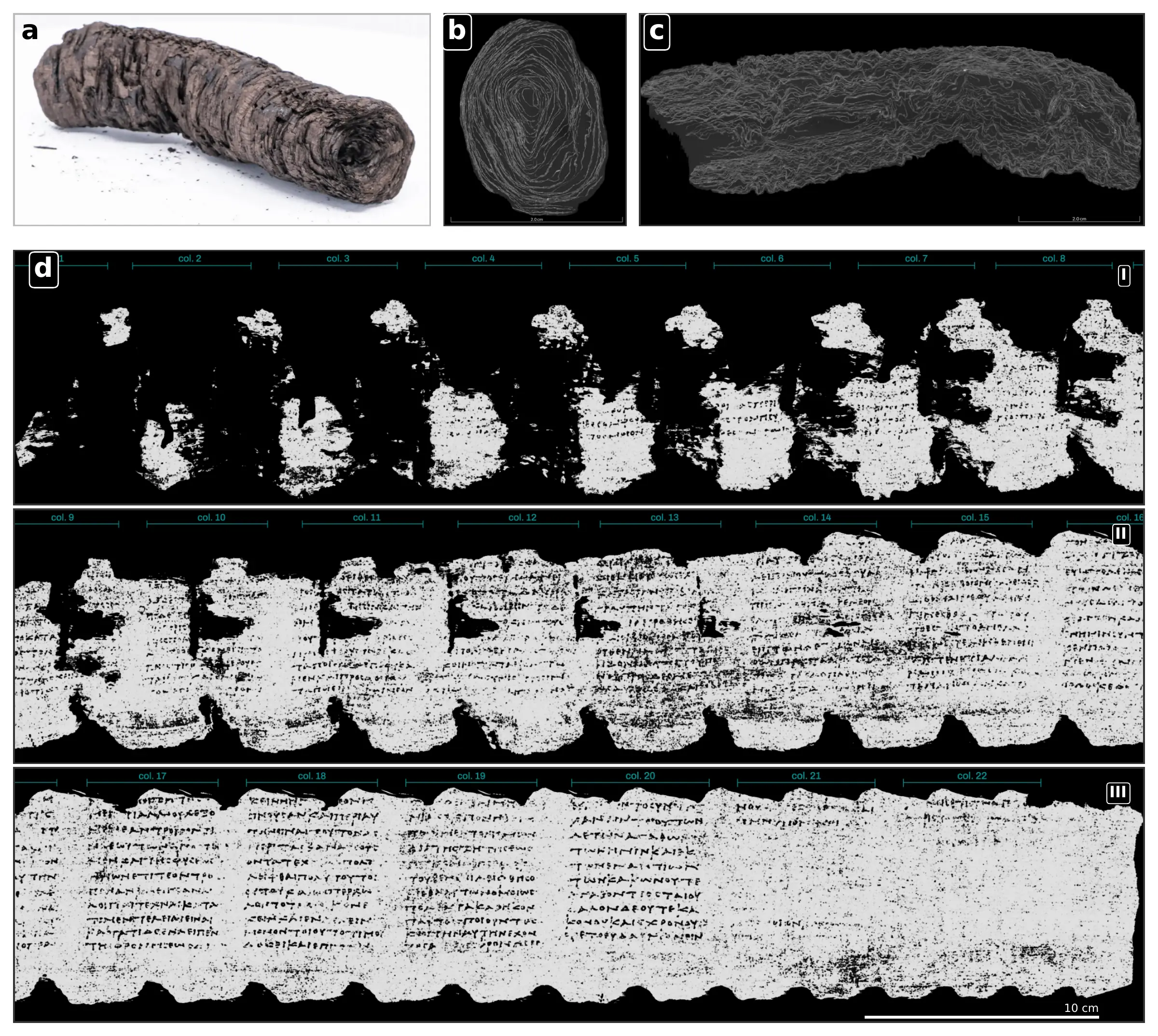
Source: Vesuvius Challenge. PHerc. 1667 shown as a sealed carbonized roll, CT cross-sections, and an unwrapped writing surface with Greek text.
Did AI really read the Herculaneum scrolls?
Yes, but the public version needs a correction.
AI did not sit alone in a room and “read history.”
The process was closer to this:
- The scroll was scanned with high-resolution X-ray microtomography.
- Researchers reconstructed the internal geometry of the papyrus layers.
- The surface was digitally flattened into a readable form.
- Machine-learning models helped detect faint ink signals.
- Papyrologists reviewed the images and produced the transcription and interpretation.
The preprint is explicit about this. Machine output was not treated as a substitute for reading. The transcription was produced and interpreted by qualified papyrologists who inspected the renderings, ink-enhanced outputs, and geometric context.
That distinction matters a lot.
The story is not “AI replaces historians.” It is “AI gives historians a way to see evidence that was physically inaccessible.”
That is the version worth paying attention to.
What the new scroll says, and what it does not say
PHerc. 1667 appears to contain a philosophical treatise on ethics.
The Vesuvius Challenge describes it as likely Stoic in context. The recovered text turns on ideas like human nature, impulse, moral progress, and practical wisdom. The final preserved column names Aristocreon, the nephew and disciple of Chrysippus, one of the major figures in Stoic philosophy.
The announcement gives translated fragments, including:
“We will inquire into something, but we will not grasp it, if in some way we depart from ourselves and from our own nature.”
That is a long way from the internet version of the story.
No, this does not reveal Atlantis. It does not prove a lost advanced civilization. It does not suddenly give us the entire library. It does not mean every unread scroll is now solved.
It means one preserved Herculaneum scroll portion can now be read in sustained sequence, with open data, code, imaging, and scholarly review behind the claim.
That is enough. It does not need exaggeration.
Can we trust a machine-learning reading of invisible ink?
This is the right skeptical question.
The best answer is not “trust the AI.” The best answer is “check the validation chain.”
The 2026 preprint describes several guardrails:
- the reconstructed surface had to be tied back to coordinates in the CT volume,
- letterforms had to remain consistent across repeated renderings or inference passes,
- readings had to be reviewed by papyrologists,
- uncertain letters were marked instead of silently cleaned up,
- PHerc. Paris 4 provided a separate validation case where ink became directly visible in the tomographic volume and could be segmented in 3D.
That does not make the work magically perfect. The authors are clear that not every scroll will automatically be readable. Results depend on preservation, scan quality, layer separation, ink contrast, geometry, and damage.
But this is exactly why the open-source part matters. The data and code are not just decoration. They let other researchers inspect, challenge, reproduce, or improve the workflow.
For a historical claim, that is much stronger than a viral headline.
How to check the sources yourself
If I were checking this topic from scratch, I would not start with the most dramatic article. I would build a source trail.
Eruption source:
Scroll breakthrough:
- Vesuvius Challenge: “We read an entire scroll, without ever opening it”
- Angelotti et al., “Complete virtual unwrapping and reading of a rolled Herculaneum papyrus”
- arXiv HTML version with transcription/translation sections
Open evidence:
Background:
The point is not to collect links for decoration. The point is to separate source types.
Pliny is a literary eyewitness source for the eruption. The papyri are material primary sources from the ancient library. The scans, data, transcription, and translation are modern scholarly access points to those artifacts. The press coverage helps explain the story, but it is not where the truth should stop.

Source: Wikimedia Commons. Map showing cities and towns affected by the eruption of Mount Vesuvius in 79 CE.
What this proves, and what it does not prove
Here is the cleanest way to read the evidence.
What it proves:
- Some Herculaneum scrolls can now be studied without physically opening them.
- PHerc. 1667 has been virtually unwrapped and read from its preserved surface.
- The recovered text appears philosophical, probably Stoic in context.
- AI and machine learning can help reveal ink signals that humans could not easily see.
- The work still depends on human scholarly review.
What it does not prove:
- It does not prove the entire Herculaneum library has been recovered.
- It does not prove every AI reading of an ancient text should be trusted.
- It does not prove the scroll is definitely by Chrysippus.
- It does not prove sensational claims about lost secrets.
This is the line I care about with history content.
The real story is usually strong enough. You do not need to inflate it.
Why this matters for primary-source research
The Herculaneum scrolls story is one of the best examples I have seen of how AI should work in history.
Not as a machine that invents a confident answer.
As a tool that helps people get closer to the source.
That is the important difference. AI can make research worse when it generates fake citations, fake quotes, and smooth summaries with no evidence behind them. But it can also make research better when it helps reveal, search, organize, and inspect real sources.
PHerc. 1667 is not exciting because a model wrote a clever paragraph about the ancient world. It is exciting because technology helped recover a real ancient text that scholars can now examine.
That is the standard I want more historical research to meet:
Find the source. Check what it says. Then make the claim.
If you want to trace a historical claim from headline to document, use the Herculaneum scrolls source finder or create a free PrimarySourceFinder account and find the sources behind your own topic.
Frequently asked questions
What are the best Herculaneum scrolls primary sources to start with?
Start with Pliny the Younger's Letters 6.16 and 6.20 for the eruption of Vesuvius, then use the Herculaneum papyri themselves, especially PHerc. 1667, plus the Vesuvius Challenge scans, preprint, open data, and code as modern access points to the ancient artifact.
Did AI really read a Herculaneum scroll?
Yes, but the careful version is that machine learning helped reveal ink signals on a virtually unwrapped scroll surface. Papyrologists still reviewed the images, transcription, and interpretation, so the result is not AI replacing historians.
Is Pliny the Younger a primary source for the Herculaneum scrolls?
Pliny is a primary source for the eruption of Vesuvius, not for the contents of the Herculaneum scrolls. His letters help establish the disaster context; the papyri and modern scans are the evidence for the scrolls themselves.
What does PHerc. 1667 prove?
PHerc. 1667 shows that at least one preserved Herculaneum papyrus portion can be virtually unwrapped and read in sustained sequence. It does not prove the entire Villa of the Papyri library has been recovered or that every AI reading of ancient texts should be trusted.
Find the primary sources behind any historical claim
Search any topic and get the most relevant primary and secondary sources, ranked by historical importance, with free copies wherever they exist online.
Find sources for your topic