Evidence over hype
Mendez v. Westminster Primary Sources: 1954 Public School Segregation
Mendez v. Westminster is often remembered as the school desegregation case before Brown v. Board of Education, the 1954 U.S. Supreme Court case that ruled public-school segregation unconstitutional. The primary sources show something more specific: families, testimony, court orders, amicus briefs, meaning friend-of-the-court legal arguments, and legal opinions that challenged segregation in California schools.
Mendez v. Westminster usually gets introduced as the school desegregation case before Brown v. Board of Education, the 1954 U.S. Supreme Court case that ruled public-school segregation unconstitutional. True, but too tidy. If I were researching it from scratch, I would start with Mendez v. Westminster primary sources, not the one-sentence legacy summary.
Mendez v. Westminster primary sources show Mexican American families using federal court records, testimony, friend-of-the-court briefs, and injunctions, meaning court orders, to challenge school segregation in Orange County, California. That version is stronger than the clean headline. The records show what parents alleged, what school officials said, how Judge Paul J. McCormick reasoned in 1946, what the Ninth Circuit, the federal appeals court for the western states, affirmed in 1947, and why later historians connect the case to Brown v. Board.
They also show why the simple anniversary version is not enough. Mendez was not decided by the U.S. Supreme Court. It did not desegregate every American school by itself. And it should not be flattened into a warm-up act for Brown v. Board. It was a specific federal case brought by specific families against specific California school districts, with a surviving paper trail that is unusually useful for students, teachers, and researchers.
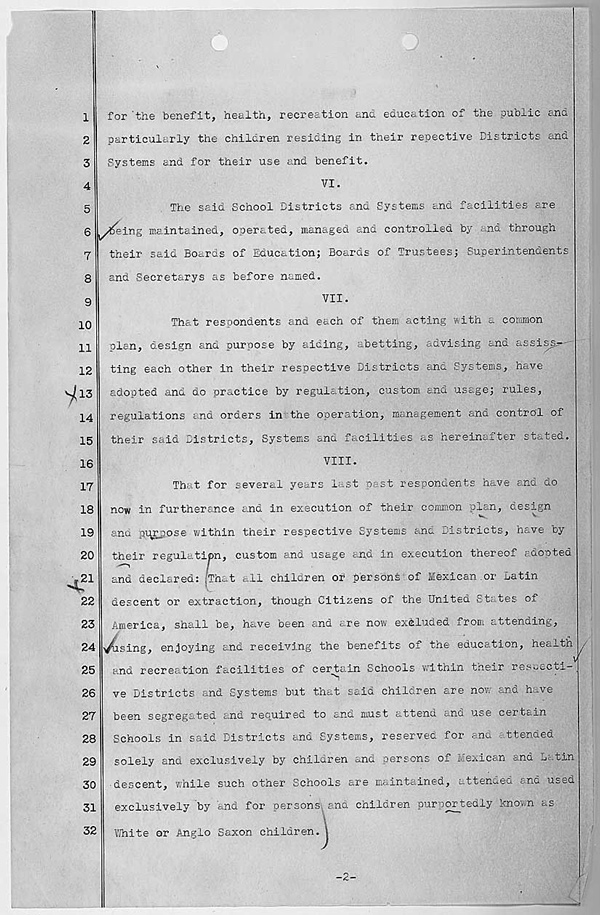
Source: National Archives. Petition filed by parents in Gonzalo Mendez et al. v. Westminster School District of Orange County et al., Civil Case File 4292.
Quick answer: where to start with Mendez v. Westminster primary sources
I would start with the National Archives Mendez v. Westminster source page. It links to the clearest public set of related primary sources through DocsTeach, including the petition, testimony, friend-of-the-court brief, conclusions of the court, and judgement and injunction.
The source trail I would use first is:
- The NARA Mendez v. Westminster page, for the official source hub.
- The petition in Mendez v. Westminster, for what the parents alleged.
- The trial testimony of Gonzalo Mendez, for courtroom testimony from the lead plaintiff.
- The testimony of Westminster superintendent Richard Harris, for how school officials explained segregation.
- The conclusions of the court, for Judge McCormick's findings.
- The judgement and injunction, for the court order telling the districts what to stop doing.
- The Library of Congress Mendez guide, for the district-court citation, research context, and additional source paths.
- The 1947 Ninth Circuit opinion text, for the appeal.
- The ACLU and National Lawyers Guild amicus brief, a friend-of-the-court argument, for civil-rights legal strategy around the case.
- The Library of Congress Latinx civil-rights guide, for context, timeline, and additional research paths.
That trail matters because no single source answers every question. The petition tells you what the families claimed. Trial testimony tells you what people said under questioning. The district court opinion tells you what the judge found. The injunction tells you what the court ordered. The appeal tells you what the Ninth Circuit, the federal appeals court, upheld. Later official explainers help with context, but treat them as context, not the core evidence. The records above are where the case becomes researchable instead of just admirable.
Here is the short version:
Petition
- Date: March 2, 1945
- What it shows: What the parents alleged and which districts were sued
- Be careful: A petition is a claim document, not a final finding
Trial testimony
- Date: July 1945
- What it shows: What parents and school officials said in court
- Be careful: Testimony records statements under questioning, not perfect memory
Amicus briefs
- Date: 1945-1947
- What it shows: How outside groups made friend-of-the-court arguments about the legal stakes
- Be careful: Briefs are arguments, not holdings
Conclusions, judgement, and injunction
- Date: 1946
- What it shows: What Judge McCormick found and ordered
- Be careful: Pair them with the reported opinion for full reasoning
Ninth Circuit opinion
- Date: 1947
- What it shows: What the federal appeals court affirmed
- Be careful: It was not a U.S. Supreme Court ruling and did not end segregation nationwide
Source trail at a glance
- The petition proves what the Mendez plaintiffs alleged; it does not by itself prove every allegation true.
- Trial transcripts record what witnesses said under questioning; they are evidence, not neutral omniscient narration.
- Findings, opinion, judgment, and injunction show the court's reasoning and what the districts were ordered to stop doing.
- The Ninth Circuit opinion shows what was affirmed on appeal and how the court framed the legal issue.
- Amicus briefs, photographs, oral histories, and commemorative sources show legal strategy, context, and memory, not the holding by themselves.
Use the companion Mendez v. Westminster source finder to search this source trail directly.
What was Mendez v. Westminster?
Mendez et al. v. Westminster School District of Orange County et al. was a federal class-action lawsuit challenging the segregation of Mexican American children in several Orange County, California school districts.
The case was brought by Gonzalo Mendez, William Guzman, Frank Palomino, Thomas Estrada, and Lorenzo Ramirez, on behalf of their children and other similarly affected children. The defendants included the Westminster, Garden Grove, and El Modeno school districts, plus Santa Ana city school officials and Board of Education members.
The basic dispute was this: Mexican American children were being separated into so-called Mexican schools or otherwise excluded from schools attended by white children. School officials often justified the practice by pointing to language, hygiene, ability, or local administrative custom. The parents argued that the practice denied their children equal protection under the Fourteenth Amendment, the constitutional guarantee that states must treat people equally under the law.
I would read the petition first because it shows how the plaintiffs framed the case. It charged that children of “Mexican and Latin” descent were excluded from the benefits of certain schools and required to attend separate schools reserved for children of Mexican and Latin descent. DocsTeach identifies the record as National Archives Identifier 294940, from Civil Case File 4292 in Record Group 21, the National Archives collection for federal district-court records.
That document does not prove every fact in the case by itself. A petition is a claim document. But it is still the right starting point because it shows the legal and moral problem as the families put it before the court.
What the petition can and cannot prove
The petition is a primary source because it was part of the legal case itself. It can prove:
- who filed the lawsuit,
- which school districts were named,
- what the parents alleged,
- how the families described discrimination,
- what constitutional theory they used,
- how the case entered federal court.
It cannot prove, alone, that every allegation was true. That is what the trial, testimony, findings, and judgement help establish.
This distinction matters. A lot of weak historical writing treats legal complaints as finished findings. Better research separates claims from proof. In Mendez, the petition is the opening argument in the source trail, not the end of it.
Trial testimony: what people said under questioning
The National Archives and DocsTeach provide selected trial transcript materials, including Gonzalo Mendez's testimony and testimony from Westminster School District superintendent Richard Harris. DocsTeach identifies Gonzalo Mendez's testimony as National Archives Identifier 6277738 and the Harris testimony as National Archives Identifier 6277737.
Gonzalo Mendez's testimony matters because it pulls the legal case back to a family decision. According to the DocsTeach description, Gonzalo and Felicitas Mendez tried to enroll their children in the Main Street School in Orange County in the fall of 1944. The district had drawn boundary lines that excluded Mexican neighborhoods, and the children were assigned to Hoover Elementary School, which was established for Mexican children.
The superintendent testimony matters for a different reason. It shows how school officials tried to justify separation. The petition page’s NARA description quotes school officials using stereotypes about Mexican children and families. Those statements are ugly to read, but they are central evidence. They show that segregation was not only about maps and classrooms. Officials also justified it through assumptions about language, hygiene, ability, culture, and belonging.
That does not mean every witness statement should be treated as neutral truth. Trial testimony proves that a person made a statement under courtroom conditions. It can reveal policy logic, prejudice, contradictions, and legal strategy. But witnesses can be mistaken, self-protective, hostile, selective, or shaped by the questions lawyers ask.
A good Mendez source trail reads testimony beside the court's findings, not instead of them. Stop making testimony do a judge's job.
Source: DocsTeach/National Archives. Trial transcript material from Mendez v. Westminster, useful for separating courtroom testimony from later summary.
What Judge McCormick decided in 1946
The district court decision is the legal center of the case. If you skip it, you are mostly repeating memory.
In February 1946, U.S. District Judge Paul J. McCormick ruled for the petitioners. The Library of Congress Mendez guide cites the reported district court opinion as Mendez v. Westminister School Dist., 64 F. Supp. 544. The misspelling “Westminister” appears in the reported case title, so researchers should search both spellings.
The court did not simply say that separate buildings were unequal because one school had worse desks or books. McCormick’s opinion went further. He wrote that equal protection in California public schools was not provided by giving Mexican ancestry children the same technical facilities, textbooks, and courses of instruction in separate schools. Public education required “social equality” and had to be open to all children by unified school association regardless of lineage.
The conclusions of the court and judgement and injunction are crucial companion documents because they show how the reasoning became court action. An injunction is a court order. Here, it barred further discriminatory practices against pupils of Mexican descent in the defendant districts.
This is where Mendez becomes more than a family story. The court treated segregation by Mexican ancestry as a constitutional problem, even when school districts said they were sorting children by language or school administration. For deeper record work, also search for the case file by formal citation and archive description: Civil Case File 4292, Gonzalo Mendez et al. v. Westminster School District of Orange County et al., Record Group 21, National Archives at Riverside.
What the 1947 federal appeals court did
The school districts appealed to the Ninth Circuit, the federal appeals court that covers California and other western states. The Ninth Circuit opinion is reported as Westminster School District of Orange County v. Mendez, 161 F.2d 774. The Ninth Circuit also hosts an official PDF of the opinion, which is useful when you want a court-hosted copy rather than a legal mirror.
The appeal is easy to overstate if you read only short summaries. This is where people get sloppy. The Ninth Circuit affirmed the result, but it did not issue a national Supreme Court ruling ending school segregation everywhere. It also did not need to overturn every earlier “separate but equal” case to decide Mendez.
The appellate opinion focused on the lack of California legislative support for the kind of segregation practiced by the school districts and on equal-protection problems created by officials acting under color of state law. That is why the appeal is important and bounded at the same time.
It affirmed relief for the families and schoolchildren in the case. It helped make Mendez a major precedent in Mexican American civil-rights history. But the broader national rule against public-school segregation came later in Brown v. Board of Education in 1954.
Why the friend-of-the-court briefs matter
The Mendez record is not just parents versus school districts. Civil-rights organizations saw the case as important while it was happening and filed amicus briefs, meaning legal arguments from outside groups that wanted to help the court think through the stakes.
DocsTeach provides the amicus brief filed by the National Lawyers Guild and the ACLU. The Ninth Circuit opinion also lists several amici, including organizations and lawyers connected to broader civil-rights litigation. The NPS account notes that the NAACP, American Jewish Congress, Japanese American Citizens League, ACLU, National Lawyers Guild, and the Attorney General of California filed briefs or supported the case at the appeals level.
This source category proves something different from testimony. Amicus briefs show legal strategy. They show how outside organizations wanted the court to think about segregation, equal protection, citizenship, and public education.
They do not prove what happened at a schoolhouse door in Westminster. They do show that Mendez was being understood as part of a wider constitutional fight while the case was active.
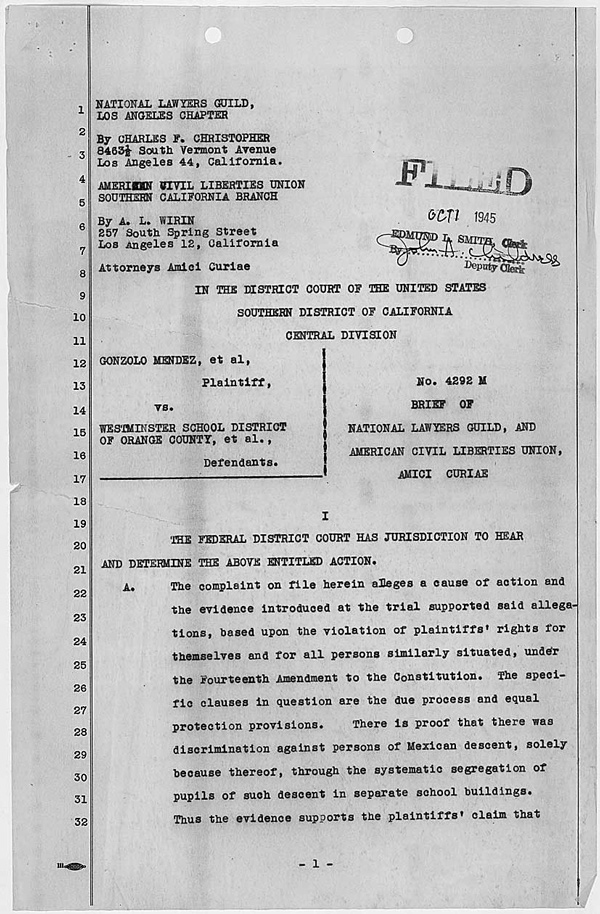
Source: National Archives. Amicus brief material from the ACLU and National Lawyers Guild in Mendez v. Westminster.
How Mendez connects to Brown v. Board without disappearing into it
A common question is whether Mendez “led to” Brown v. Board. The careful answer is less neat: it helped shape the legal and political path, but it was not a direct Supreme Court precedent controlling Brown v. Board.
Mendez came before Brown v. Board. It challenged school segregation in federal court. It drew amicus participation from civil-rights organizations. It used arguments about equal protection, education, stigma, social equality, and the harms of segregation. Several later accounts, including official U.S. Courts and NPS pages, connect Mendez to the litigation strategy that preceded Brown v. Board.
But Mendez was also its own case. It involved Mexican American families in Orange County. It emerged from California law, local school-district practices, and the racial classification contradictions of the period. Mexican Americans could be classified as legally white while still being segregated in practice because of ancestry, surname, language assumptions, and local custom.
If an article treats Mendez only as the school-desegregation case that came before Brown v. Board, it misses the central lesson. The primary sources show that discrimination does not always appear in the legal form people expect. It can operate through district boundaries, administrative categories, language claims, and local habits officials defend as normal.
Why Mexican American children were segregated if they were legally classified as white
This is one of the parts of the case modern readers can miss if they go in looking for the wrong kind of source.
The Library of Congress guide explains that Mexican Americans were legally classified as white in the census context, but schools in California still created separate Mexican schools. The practice often depended on ancestry, surname, neighborhood, appearance, assumptions about English ability, and claims about cultural difference.
That contradiction is exactly why the sources matter. The story sounds simple until the records complicate it. If you only look for a statute saying “segregate Mexican American children,” you may miss how segregation actually worked. In Mendez, school officials could claim that separation was about language or school administration. The plaintiffs argued that the effect was discrimination against children of Mexican and Latin descent.
The district court accepted that the practices denied equal protection. That is the evidence trail: not a simple law on one side and a simple violation on the other, but a pattern of official practices that operated through public schools.
What court records leave out
Court records are powerful. They are not complete history.
They tell you what made it into the legal case. They preserve filings, testimony, arguments, findings, and orders. They show how the court translated lived discrimination into legal categories.
They leave out other things:
- private family conversations,
- children’s full emotional experience,
- everyday classroom treatment,
- organizing work not captured in filings,
- local memories outside the court record,
- later consequences that took years to unfold.
That is why I would still pair court records with oral histories, local archives, photographs, school records, newspaper coverage, and later interviews. The Chapman University Mendez archive is useful here because it includes photographs, local school materials, and commemorative records. These do not replace the court file. They widen the frame.

Source: Wikimedia Commons. Sylvia Mendez speaking at a 2014 U.S. Army Corps of Engineers event, useful as a public-memory image rather than a 1940s trial record.
How to research Mendez v. Westminster without getting misled
I would use the sources in layers.
First, read the petition. Ask: what did the families allege?
Second, read trial testimony. Ask: what did parents and school officials say under questioning?
Third, read the conclusions of the court and district court opinion. Ask: what did Judge McCormick find, and what legal reasoning did he use?
Fourth, read the injunction. Ask: what was the court actually ordering school officials to stop doing?
Fifth, read the Ninth Circuit opinion. Ask: what did the federal appeals court affirm, and what did it avoid deciding?
Sixth, read the amicus briefs, meaning friend-of-the-court arguments, and official context pages. Ask: how did other civil-rights actors interpret the stakes?
Finally, add photographs, oral histories, local school records, and later commemorative sources. Ask: what do these sources add about memory, community, and legacy that the court documents do not show?
That layered approach prevents two mistakes. One is treating Mendez as a simple heroic summary without evidence. The other is treating court documents as if they contain every human part of the story.
What the records prove
The strongest primary sources support several careful conclusions.
They show that Mexican American families challenged segregation in multiple Orange County school districts. They show that the plaintiffs framed the case as a constitutional equal-protection issue. They show that school officials defended separation through language, ancestry, administrative, and stereotyped claims. They show that Judge McCormick ruled for the families in 1946. They show that an injunction issued against discriminatory practices. They show that the Ninth Circuit affirmed in 1947. They show that civil-rights organizations understood the case as part of a broader fight against segregated education.
They also help answer a common source question: was Mendez about race, language, or both? The safest answer is that the records show a documented tension. School districts used language and assimilation arguments, but the petition, testimony, and opinions show separation tied to Mexican or Latin descent, ancestry, names, appearance, and local racialized practice. Treating it as only an English-language placement case misses the equal-protection problem. Treating it as exactly the same legal structure as Southern Jim Crow also flattens the source trail.
They do not prove that Mendez alone ended school segregation across the United States. They do not prove that school integration became easy or immediate. They do not prove that Mexican American civil-rights history should be treated as a footnote to Black civil-rights litigation. And they do not remove the need to study Brown v. Board, Lemon Grove, Hernandez v. Texas, Westminster local history, California school law, or later desegregation struggles.
That is the real value of Mendez v. Westminster primary sources. They make the story clearer, but less flattened. That is usually what good records do.
Why this source trail fits Primary Source Finder
Mendez v. Westminster is exactly the kind of case where source-first research changes the story.
A summary gives you the headline: Mexican American families challenged school segregation before Brown v. Board. The primary sources give you the mechanics: petition, testimony, stereotypes, expert evidence, equal-protection reasoning, injunction, appeal, amicus strategy, and later public memory.
That difference matters. History is not just knowing the outcome. It is knowing which records support the outcome, which claims are still interpretive, and where the evidence stops. That is the whole PSF bet, and Mendez is a clean example of why I care about it.
Create a free PrimarySourceFinder account or use the companion Mendez v. Westminster source finder to find the source trail, separate primary evidence from later summary, and check what a document can and cannot prove before the story hardens into a slogan.
Frequently asked questions
Are Mendez v. Westminster court records primary sources?
Yes. The petition, trial transcripts, amicus briefs, conclusions of the court, judgement and injunction, district court opinion, and Ninth Circuit opinion are primary sources for the case. They were created as part of the legal dispute or its official resolution.
Where can I read Mendez v. Westminster primary sources online?
Start with the National Archives Mendez page and DocsTeach records. Then use Justia for the district court and Ninth Circuit opinion texts, the Library of Congress guide for context, and Chapman Digital Commons for additional photographs and local archival materials.
Did Mendez v. Westminster happen before Brown v. Board of Education?
Yes. The district court ruled in 1946 and the Ninth Circuit affirmed in 1947. Brown v. Board of Education was decided by the U.S. Supreme Court in 1954.
Did Mendez v. Westminster directly overturn school segregation nationwide?
No. Mendez was a federal case in California and the Ninth Circuit. It was important, influential, and legally significant, but the nationwide Supreme Court ruling against public-school segregation came later in Brown.
What did Judge McCormick decide?
Judge Paul J. McCormick ruled that the school districts’ segregation practices denied equal protection and ordered relief against further discriminatory practices. His opinion emphasized that equal protection in public education required more than technically similar facilities in separate schools.
Find the primary sources behind any historical claim
Search any topic and get the most relevant primary and secondary sources, ranked by historical importance, with free copies wherever they exist online.
Find sources for your topic