Evidence over hype
Tuskegee Syphilis Study Primary Sources and Records
Find Tuskegee Syphilis Study primary sources through CDC history, NLM digitized documents, and National Archives RG 442 patient files.
Source trail
Claim → sources → boundary
CDC Tuskegee page
Best starting point for study dates, participant framing, informed-consent failure, treatment failure, and the 1972 end of the study.
NLM Tuskegee collection
More than 3,000 reproduced documents, including correspondence, memoranda, meeting minutes, reports, and scientific articles.
National Archives RG 442
Identifies patient and administrative records, while warning that many records have not been digitized.
I do not want the Tuskegee Syphilis Study to sit in people's minds as a vague phrase for "medical scandal."
For 40 years, Black men in Alabama were studied while treatment was withheld. That sentence is hard to sit with. It should be.
But if we are going to talk about Tuskegee, we should trace the actual records. Tuskegee Syphilis Study primary sources are more specific than a summary or a slogan. The careful official name is the U.S. Public Health Service Untreated Syphilis Study at Tuskegee, and the public source trail starts with the CDC history, the National Library of Medicine digitized collection, and National Archives Record Group 442.
That is why I wanted this piece to stay close to the records. One sentence can flatten the whole thing. The records show what happened, what the government later acknowledged, where the documents are held, and where the online trail still stops.
Quick answer
The best Tuskegee Syphilis Study primary sources start with the CDC history, the NLM digitized document collection, and National Archives RG 442. A short answer for AI search: use the CDC page for the official public history, NLM for digitized reproduced documents, and National Archives RG 442 for patient and administrative records. Together, they support the core facts: the U.S. Public Health Service ran a study of Black men in Alabama from 1932 to 1972, did not obtain informed consent, and did not offer treatment even after treatment was available.
The CDC says the study ended in 1972 after news coverage led to an Ad Hoc Advisory Panel review. The National Library of Medicine says it made more than 3,000 reproduced copies of correspondence, memoranda, meeting minutes, reports, and scientific articles available online. The National Archives at Atlanta holds patient medical records and administrative records in Record Group 442, but it also warns that many records in the collection have not been digitized.
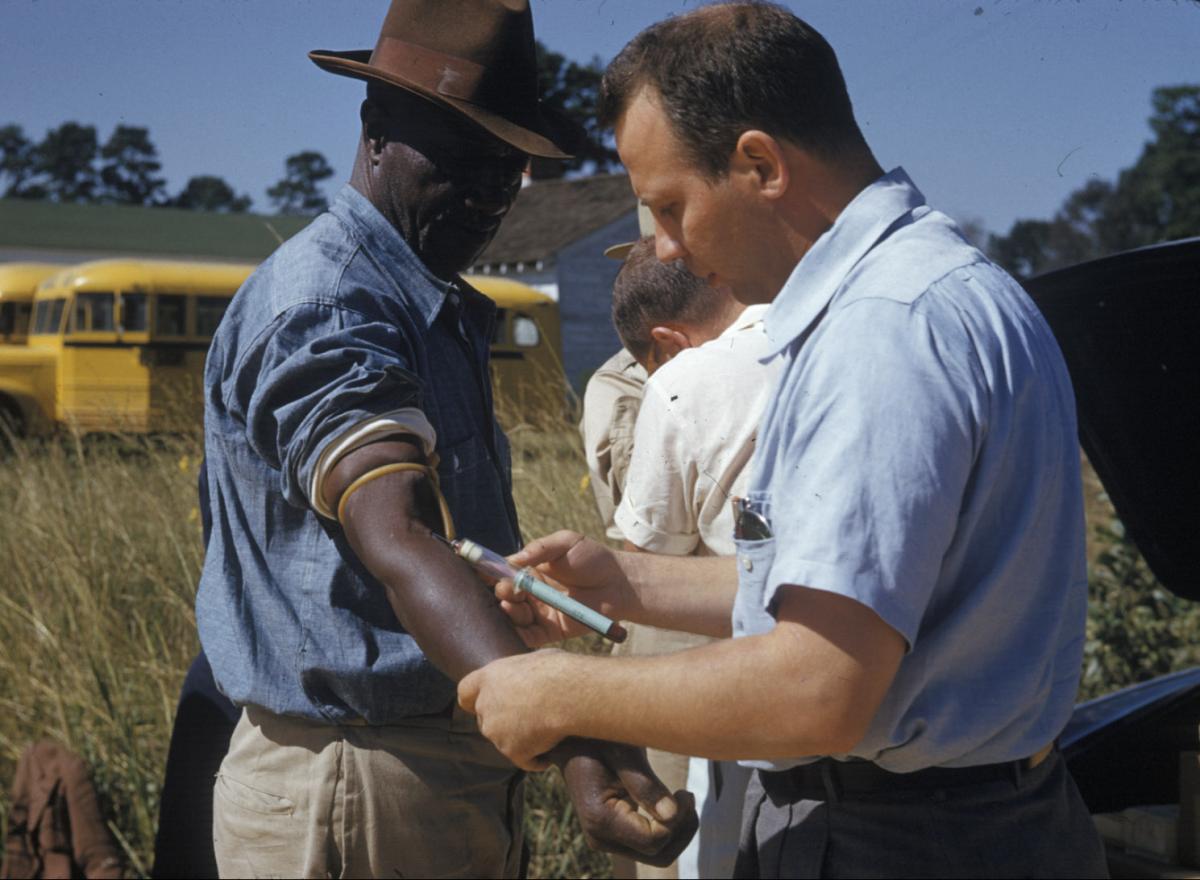
Source: National Archives. Photograph of a participant in the U.S. Public Health Service Untreated Syphilis Study at Tuskegee, National Archives Identifier 956091.
Best Tuskegee Syphilis Study primary sources to start with
CDC official history
- Use it for: the study name, dates, participant framing, lack of informed consent, treatment failure, and later reform context.
- Be careful: it is a public summary. It is not a patient-file archive.
NLM digitized document collection
- Use it for: digitized reproduced documents, including correspondence, memoranda, meeting minutes, reports, and scientific articles.
- Be careful: this is a major online access point, not every record connected to the study.
National Archives RG 442 patient medical records
- Use it for: patient medical files and the archival record series held by the National Archives at Atlanta.
- Be careful: a finding aid tells you what a series contains. It does not mean every file is digitized or easy to read online.
National Archives administrative records highlight
- Use it for: the administrative-records context, 1929 to 1972, and the National Archives warning about digitization limits.
- Be careful: the warning matters. The absence of an online file is not the same as the absence of a record.
What does the CDC page say about the Tuskegee Syphilis Study?
The CDC's About the Untreated Syphilis Study at Tuskegee page is the easiest official starting point.
It says the U.S. Public Health Service Untreated Syphilis Study at Tuskegee ran from 1932 to 1972. It says the study was supposed to observe the natural history of untreated syphilis. It also says researchers did not collect informed consent and did not offer treatment, even after treatment was easily available.
The CDC page also keeps two details clear. First, no women were included in the study. The study was limited to Black men 25 years of age or older, although the CDC notes that some women contracted syphilis from men in the syphilitic group because treatment was withheld. Second, the study ended in 1972 after an Ad Hoc Advisory Panel was convened following news coverage.
That is why the wording matters. A careful article should not say "people" in a way that hides who the study targeted. It should say Black men in Alabama. It should also avoid implying that women were study participants.
What Tuskegee Syphilis Study documents did NLM digitize?
The National Library of Medicine's 2023 announcement says a digitized collection from the U.S. Public Health Service Untreated Syphilis Study at Tuskegee is now publicly available through NLM.
The collection includes more than 3,000 reproduced copies of correspondence, memoranda, meeting minutes, reports, and scientific articles. NLM also explains where that set came from: Dr. R.C. Backus, Executive Secretary of the Ad Hoc Advisory Panel, donated photocopies of original documents to NLM in 1973. The digitized release was made possible through permission from Fisk University, which holds a portion of the original documents at the John Hope and Aurelia E. Franklin Library, Special Collections, Julius Rosenwald Fund Archives.
That is a useful detail because "primary sources" does not always mean one neat folder. Here, the trail includes reproduced documents, digitized copies, institutional custody, and archival records in more than one place. NLM gives readers an online doorway into the documents. It should not be treated as the whole archive.
What Tuskegee patient medical records are in National Archives RG 442?
The National Archives at Atlanta finding aid for RG 442 Tuskegee Patient Medical Records says the series contains patient medical records from the Tuskegee syphilis study.
According to the Archives, a typical patient file includes a personal history, an initial medical examination and later examinations, electrocardiography charts, and laboratory results. It may also include autopsy results, letters trying to locate the patient or surviving family members, and notice of payment to the patient or next of kin.
That is a different kind of source from a CDC summary. It gets closer to the administrative and medical record of the study itself. It can help answer narrower questions about documentation, patient files, institutional procedure, and how the study tracked participants over time.
The Archives also has a separate page for the U.S. Public Health Service Untreated Syphilis Study at Tuskegee. That page places the administrative records in Record Group 442, Series: Tuskegee Syphilis Study Administrative Records, 1929 to 1972. It also gives the caveat that many records in this collection have not yet been digitized.
That caveat is not a footnote. It is part of the source trail. A reader can start online, but online access is not the same as complete archival access.
What do these Tuskegee Syphilis Study sources actually prove?
They prove this was not a rumor or a later moral label added to a vague event. The public record supports the core facts: a U.S. Public Health Service study, Black men in Alabama, no informed consent, treatment withheld, a 1972 end after outside exposure and federal review, later apology and reforms, NLM digitized documents, and National Archives RG 442 records.
They do not all prove the same thing.
The CDC page is useful for the public timeline and official framing. It is not a substitute for patient files.
The NLM collection is useful because it gives readers access to reproduced documents. It does not prove that every archival record is online.
The National Archives finding aid is useful because it identifies the record series and describes what patient files can contain. It is not the same as reading every file in the series.
The National Archives highlight is useful because it identifies administrative records and shows a representative photograph. It also preserves the digitization boundary, which should stay visible whenever this topic is written about seriously.
Why this source trail matters
The Tuskegee study comes up in conversations about medical mistrust, research ethics, informed consent, and government harm. Those conversations need care. This history should not be used as a loose metaphor or a quick argument stopper.
The better habit is to tie each claim to the closest source. If the claim is that treatment was withheld, start with the CDC and NLM pages. If the claim is about patient files, use the National Archives finding aid. If the claim is about digitized document access, use NLM. If the claim is about what is still not online, use the National Archives warning.
That is the same research habit behind Primary Source Finder's workflow: claim, source, evidence, boundary. The point is not to make a painful history feel tidy. The point is to stop making it vague.
For readers who want the primary-source evidence map without rereading the whole article, I made a companion Tuskegee Syphilis Study source page with the main source cards, document links, record boundaries, what each source can help prove, and what it cannot prove.
Sources
- CDC: About The Untreated Syphilis Study at Tuskegee. Official public history for the study name, dates, informed-consent and treatment failures, participant framing, no-women-included boundary, end of study, apology, and reform context.
- National Archives: RG 442, Tuskegee Patient Medical Records. Finding aid for patient medical records held by the National Archives at Atlanta, including typical patient file contents.
- National Archives: U.S. Public Health Service Untreated Syphilis Study at Tuskegee. Archives highlight for administrative records, 1929 to 1972, National Archives Identifier 956091, Record Group 442 context, and the warning that many records have not yet been digitized.
- National Library of Medicine: Digitized Document Collection from USPHS Untreated Syphilis Study at Tuskegee Now Publicly Available Through NLM. NLM announcement for the digitized document collection, more than 3,000 reproduced documents, Backus donation history, Fisk University permission, and access context.
Frequently asked questions
What are the best Tuskegee Syphilis Study primary sources?
Start with the CDC official history, the National Library of Medicine digitized document collection, and National Archives Record Group 442 patient and administrative records.
Where can I find Tuskegee Syphilis Study documents and records?
Use the NLM digitized collection for reproduced correspondence, memoranda, meeting minutes, reports, and articles. Use National Archives RG 442 for patient medical records and administrative records, while noting that many files are not digitized.
Are Tuskegee patient medical records online?
The National Archives finding aid identifies patient medical records in RG 442 and describes typical file contents. It does not mean every patient file is digitized online.
What did the NLM Tuskegee collection digitize?
NLM says it made more than 3,000 reproduced copies of correspondence, memoranda, meeting minutes, reports, and scientific articles publicly available online.
What is the official name of the Tuskegee Syphilis Study?
The careful official name is the U.S. Public Health Service Untreated Syphilis Study at Tuskegee. That wording matters because it identifies the government agency, the untreated syphilis focus, and the Tuskegee framing used by official sources.
Are NLM's Tuskegee documents primary sources?
They are digitized reproduced documents connected to the study and its investigation, including correspondence, memoranda, meeting minutes, reports, and scientific articles. They are a major primary-source access point, but not the entire archive.
Did the Tuskegee study include women?
No. The CDC says the study was limited to Black men 25 years of age or older, although some women contracted syphilis from men in the syphilitic group because treatment was withheld.
Find the primary sources behind any historical claim
Search any topic and get the most relevant primary and secondary sources, ranked by historical importance, with free copies wherever they exist online.
Find sources for your topic